Invisibility or Visible Ageing?

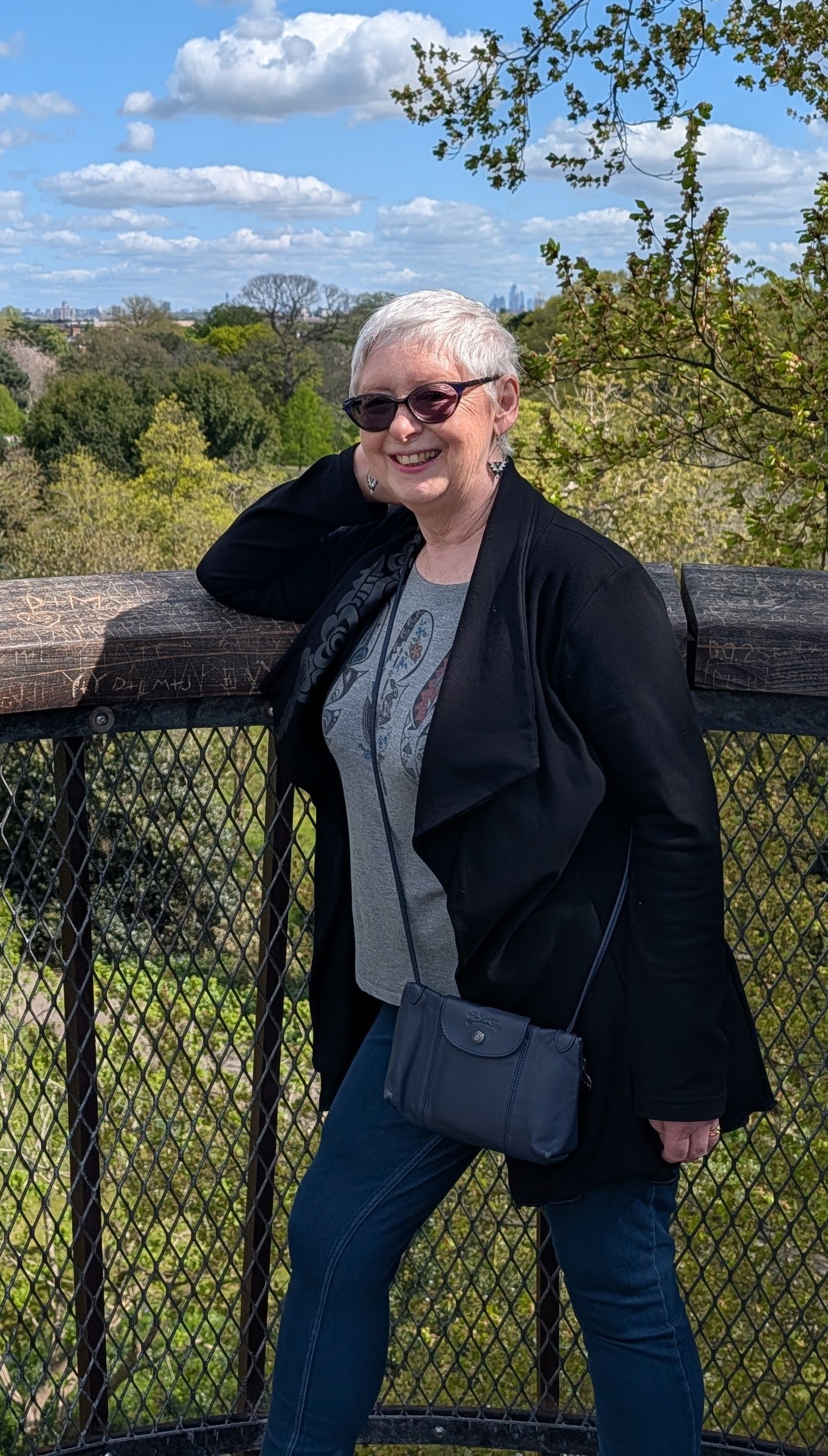
The author (67), April 2026

There is an increasingly clamorous cultural narrative about the invisibility of women over fifty. Whilst it is important to challenge any form of marginalization, I think it is also valuable to embrace our own personal stories. And I don’t believe that these have to be dominated by a negative sense of invisibility. We have choices.

The narrative is not entirely false. In my late sixties, I have sat at the edge of a younger group in a large gathering and dared to say something only to be blanked as if I am not really there.

But, honestly, often I now feel more visible in ways that matter to me than I did as a younger woman.

The visible self

I think that a part of that perception of visibility or invisibility rests in our sense of ourselves. It takes time and effort to understand who we are as we move into a life stage so much less defined by career and appearance. But unless we are able to vision who we are becoming, then to some extent we are not fully visible to ourselves.

Coming to Canada at fifty-one, I made a very conscious choice to live as authentically as possible. What needs I may have had for approval, to be ‘liked’, had significantly diminished by then. To my surprise, I found an immediacy of deep connection with others as never before, people I call ‘heart-kin’.

I had become interested in developing an understanding of what elderhood might look like in contemporary society in my forties when I worked in dementia care. I now began to delve deeper into this (see Sage in training – modern elderhood – Passage To Joy) and what it might mean to me to embrace Crone qualities (see The season of the Crone – Passage To Joy). It didn’t happen overnight, but I have gradually come to a clear sense of who I am and want to be moving forward, as well as of those things I want (and need) to let go of.

I am perhaps more fully visible to myself than ever before, able to see what feeds my soul and what depletes it. There is an incredible energy and sense of freedom in this.

Sitting in meditation one day, I had a delightfully ‘silly moment’ when the thought that popped into my head was I want to be a lighthouse when I grow up’. This became the basis of the Sankalpa, affirmation, that I use in Yoga Nidra and other contexts:

‘I am radiant with health, love, joy and abundance’.

Choosing to be seen

I don’t know if or how this transmits to others, though at some level it seems to. It would certainly be my wish to carry with me some sense of light.

I am still surprised when young women comment ‘I love your dress, your earrings’. That kind of visibility feels unexpected at my age. Sometimes it comes out of nowhere, but more often it emerges from a deeper conversation.

I was definitely startled by the young man in a coffee shop who opened what turned into a deep conversation with ‘are you a very spiritual person?’ He claimed to see my aura and looked to me for insights.

There was the group of much younger colleagues at a conference who, when I commented on our relative age, paid Paul and myself the loveliest compliment: ‘yes, but you have young energy!’ I wear my wrinkles as a badge of honour. But I hope to carry forward joy, zest and an ability to embrace life to the full for as many years as I am granted.

Most recently there was a wonderful conversation in the AGO (Art Gallery of Ontario) with a young man who had just graduated and was considering his next steps. As we contemplated a beautiful print by Newfoundland artist David Blackwood, an extraordinarily deep if fleeting connection seemed to form. Some twenty minutes later, he was seeking my guidance on thoughts that might be important in shaping a good life.

My daughter teases me for my willingness to talk to anyone and for my openness. But the depth of these brief encounters with much younger people is often startling, rich, joyous and humbling. I experience them as a delightful and heartwarming gift. I am also honoured to be allowed to see into the lives of these young strangers. It is not that ‘being seen’ is particularly important to me in itself. But it seems to open up a connection that is genuine and meaningful.

So I choose to be seen and rarely feel invisible.

The cloak of invisibility

For many women, though, there is a relief in casting off a requirement to pander to social expectations of appearances and roles and donning a cloak of invisibility. They revel in saying what they want and knowing that they can get away with it. They go their own way uncensured, unnoticed, with freedom to observe, think and act, and find it profoundly liberating, a secret super-power. The release from the demands and needs of others may be experienced as a quiet joy rather than a loss.

Liberty

“The truth is, it’s only when you stop worrying about becoming ‘invisible’ that you are able to see yourself. Then you are free. Free to decide what matters to you and what never will, whose opinions you value and whose you can disregard, and what exactly is worth your precious hours on this earth and what is a waste of damn time. And really, what could be more beautiful than that?”

Benedetta Barzini, quoted in Wit & Wisdom from 14 Age-Defying Women in British Vogue

If we stop fearing aging and recognize it as the gift it is, we are much more able to see into the heart of ourselves, our true beauty. And once we are visible to ourselves, the choice is ours as to how we shape the narrative of our visibility.

The Grammar of Animacy

Can a simple pronoun help change the world? Is it possible that, by learning from Indigenous peoples the grammar of animacy, we might fundamentally change the way in which we relate to the world around us?

The words we use shape how we understand ourselves, how we interpret the world, how we treat others. . . Words make worlds. 1

Beings not things

Three years ago, in The Language of Animacy, I wrote how in her wonderful book, Braiding Sweetgrass, Robin Wall Kimmerer ‘gifted me with one of those precious moments of illumination that shift the world on its axis.’

She speaks of the way in which Indigenous languages depend less on static nouns and more on verbs in relation to what is perceived as ‘animate’. In Potawatomi, as well as plants and animals, the animate includes rocks, mountains, water, fire, places. These become ‘beings’ instead of ‘things’ (objects).

Morning mist on the lake

Those beings imbued with spirit deserve their own grammar – including our sacred medicines, our songs, drums and even stories are animate. 3

‘It’ as objectification

Dragonfly emerging

When we call an animal, a flower, a tree, a river or lake ‘it’, we objectify those things. This is not the grammar of respect. It reduces any sense of moral responsibility that we might have. Would you refer to a person as ‘it’? To do so would be insulting, robbing that person of selfhood and kinship. And yet we speak of Mother Earth and the beings with whom we share the Earth as ‘it’.

Speaking with the grammar of animacy requires that we relate from moral consideration. We have to have ecological compassion for the ‘beings’ around us.

When we connect to the world from beingness, kinship, story, spiritual tradition, it is a joy to be in the world that way!

Robin Wall Kimmerer takes this further to suggest that Indigenous languages were seen as a threat to colonization:

The language we speak is an affront to the ears of the colonist in every way, because it is a language that challenges the fundamental tenets of Western thinking—that humans alone are possessed of rights and all the rest of the living world exists for human use. Those whom my ancestors called relatives were renamed natural resources . . . Replacing the aboriginal idea of land as a revered living being with the colonial understanding of land as a warehouse of natural resources was essential to Manifest Destiny, so languages that told a different story were an enemy.4

The impact of objectification is summed up beautifully in a poem by Cherokee writer Marilou Awiakata 5:

When Earth Becomes an “It”

When the people call the Earth “Mother,”
They take with love
And with love give back
So that all may live.

When the people call Earth “it,”
They use her
Consume her strength. Then the people die.

Already the sun is hot
Out of season.
Our Mother’s breast
Is going dry.
She is taking all green
Into her heart
And will not turn back
Until we call her
By her name.

‘Ki’ – an alternative pronoun in the grammar of animacy

In consultation with her elder and language guide, Stewart King, Robin Wall Kimmerer began to explore the possibility of an alternative pronoun that might be used within the English language to help reconnect us.

She began from Aakibmaadiziiwin, which means ‘a being of the earth’, bmaadiziaki – ‘an earth being’. Looking for something simpler that fits more easily as an English pronoun, she arrived with some delight at ki.

Ki to signify a being of the living earth. Not he or she, but ki. So that when the robin warbles on a summer morning, we can say, “Ki is singing up the sun.” Ki runs through the branches on squirrel feet, ki howls at the moon, ki’s branches sway in the pine-scented breeze, all alive in our language as in our world. 4

Others have commented that the sound ‘kee’ has resonance with ‘qui’ (who) in the Latinate languages. Ki is also a parallel spelling of qi or chi, the Chinese word for the life-force energy that flows through all things. It is used similarly in Japanese (spirit, mind, nature, air or energy). It already carries some weight of meaning within common usage.

There is, too, an obvious plural form, kin. What could be more perfect? Kin brings us into the community of all that lives, a state of belonging. For a long time, I have referred to my dearest friends as ‘heart-kin’. Now all those beings who surround us in the beautiful place we call home, including the trees, the rocks, the lake, are also embraced in the word kin. And I recognize them as my greatest teachers.

Dr. Wall Kimmerer, a biologist, decorated professor, and enrolled member of the Citizen Potawatomi Nation, leads her students to explore nature from both Western and Indigenous perspectives. When she introduces them to the idea of ki, for many it profoundly shifts their relationship with the world around them. It is easy to pick up a saw to cut down an ‘it’, even if you name it Maple or Birch. But when that tree is perceived as ki, a living being, there is connection, moral responsibility and gratitude that requires a much greater consciousness of that act.

Autumn on the Lake

If pronouns can kindle empathy, I want to shower the world with their sound. 4

Making ‘ki’ personal

During the wonderful speaker session6 that prompted this post, there was some commentary in the chat about choosing to adopt ki as an alternative personal pronoun. I am drawn to this, though as an additional rather than alternative pronoun. I identify comfortably as ‘she/her’. But it strikes me that it specifies what I am not as much as what I am. There is an implicit ‘othering’ in this. It certainly doesn’t define me.

I am, though, absolutely, an ‘earth-being’, seeking to live in kinship with all that is. So my pronouns should be ki/she/her. This represents me much more fully and inclusively. It also speaks of my commitment to living consciously with gratitude and to my openness to learning from all beings.

Words as activism

I stand with Robin Wall Kimmerer in her view that the words we choose can be transformative and a force of creative resistance. And I loved that she encouraged us to ‘do it with joy!’

Language can be a tool for cultural transformation. Make no mistake: “Ki” and “kin” are revolutionary pronouns. Words have power to shape our thoughts and our actions. On behalf of the living world, let us learn the grammar of animacy. We can keep “it” to speak of bulldozers and paperclips, but every time we say “ki” let our words reaffirm our respect and kinship with the more-than-human world. Let us speak of the beings of the earth as the “kin” they are. 5

References

1 Becoming Wise, Krista Tippett – Becoming Wise: An Inquiry into the Mystery and Art of Living by Krista Tippett | Goodreads

2 Braiding Sweetgrass, Robin Wall Kimmerer- Braiding Sweetgrass: Indigenous Wisdom, Scientific Knowledge, and the Teachings of Plants by Robin Wall Kimmerer | Goodreads

3 Robin Wall Kimmererin Learning the Grammar of Animacy (The Leopold Outlook Winter 2012) https://xenoflesh.wordpress.com/wp-content/uploads/2017/03/robin-wall-kimmerer.pdf

4 Robin Wall Kimmerer, Speaking of Nature – finding language that affirms our kinship with the natural world  Speaking of Nature – Orion Magazine

5 When Earth Becomes an “It” Keynote address, Geography of Hope conference, March 2015  When Earth Becomes an “It” – Dark Matter Women Witnessing (The poem When Earth Becomes an “It” is quoted in the article.)

6 With much gratitude for the wonderful speaker session with Robin Wall Kimmerer entitled Land, Love, Language – Healing our relationship with the natural world on January 18, 2024, part of the 4 Seasons of Indigenous Learning 2024-2025 Course

I thoroughly recommend the reading of any or all of the above articles – I’ve barely scratched the surface in my post and they are full of riches.

I have not yet read Krista Tippett’s book but look forward to doing so.

In every emotion a passage to joy

I managed to listen to a few sessions from the 2022 Global Joy Summit. The focus of the second day was The Inseparability of Joy and Sorrow. I have long defined joy itself not as an emotion but as a way of being. What struck me was that there can be in every emotion a passage to joy.

We often separate our emotions into those we find difficult and those we think of as pleasurable. But the more I think about it, the more it seems to me that all our emotions rise up from our inner wilds. Every emotion brings its own gifts, and, with self-compassion, we have the ability to befriend them and channel them for the greatest good of self and others. But every emotion, even those we may think of as ‘positive’, has a shadow capacity for harm if allowed to run amok.

Anger

It’s easy to see that anger can be destructive. However, at its best, anger is also protective. It flags to us when our boundaries are being breached, when we are veering off course. It can also usefully inspire us to activism in response to perceived injustices, provide an impetus for change.

But, as a red-headed Celt, I know only too well the pain I can inflict on myself and others when, instead of being able to observe and be with my anger, I flare into a spike of adrenalin and words I will inevitably regret.

If an emotion is causing harm, it is likely turning sour.

I learned as a child to suppress my anger. I was ‘baited’ by my peers once they discovered I had a temper. So, for too long, I didn’t listen to its voice until I was overwhelmed by it. It has taken me many decades to begin to learn instead to recognize anger’s promptings, to acknowledge these both internally and with a brief expression, but then to attempt to stand back, breathe, and to see what is really required. Often the question is ‘what do I (or we) need to do differently?’ It may involve a re-stating of boundaries. I definitely find humor a helpful tool in defusing the moment. I think I am still better at accessing compassion for others than self-compassion though.

For me, anger’s relationship to joy is that it brings me back to my authentic self by enabling me to uphold my personal boundaries. It takes me to the place of what the Dalai Lama terms wise selfishness, a key component in cultivating joy. And when my anger is aroused by social issues, it ignites my compassion and connects me to an awareness of our shared humanity, at the heart of which is joy.

Sadness and grief

More than anything, sadness speaks to what we care about. Sadness and grief underpin our humanity.

Tears mark what is sacred.

Life is never static. Sadness and grief orient us to loss and impermanence. They draw us to necessary reflection, a slowing into quietness, ultimately to an understanding of the importance of presence in the moment. The root of grief is often love.

To be able to sit with sadness and grief is vitally important. If we try to block out the pain, it will stay with us, haunt us, and we will become stuck in a destructive cycle.

The acceptance of impermanence, that all things, all emotions pass – so implicit in grief and sadness – is another cornerstone of joy.

Happiness

‘Can happiness ever become excessive?’, I wondered.

We think of happiness as a positive emotion. Mostly it is, nourishing our sense of wellbeing. Finding delight in the everyday is no small part of the way in which I cultivate my capacity for joy. I talked about this in my post Joy and delight in challenging times.

I recognize in myself, though, a tendency sometimes to let the good times spiral. We speak of high mood, high energy, high times. Yet that ‘high’ too easily can take on an addictive edge, become excessive pleasure seeking, or pull us towards something more like mania or obsession.


I think that the acknowledgement of toxic positivity implies a recognition that there can be a distortion when we overemphasize ‘positive’ emotions and avoid the ‘negative’. Avoidance is a form of resistance and ultimately what we resist persists and can easily become poisonous to self and others.

It is interesting to look deeply at the emotions we term ‘positive’ and take heed of their shadows as well as to look for the gifts within those we experience as ‘difficult’.

Owning opportunities for growth, new insights, the deepening of our humanity and compassion by truly experiencing what we feel, is very different from avoidance. To me it implies that awareness of the thread that connects us to joy even when we are in the midst of suffering.


Friending the inner wilds

Our emotions are our constant companions. Too often, though, we fail to become truly familiar with them. We need our passions, for all their wildness. The more we are able to sit with them, to listen, to be, to let them flow through us, the easier it becomes to see all our emotions as friends rather than threats and to appreciate what they do for us. At the same time, we may gain an understanding of the ways in which we habitually inflate their more harmful aspects and develop strategies to defuse these.

This is a very personal process. Emotions are not as universally recognizable as we tend to think. At a macro level, recent research highlights cultural differences in emotional experience and expression. This implies to me that our individual emotions will have been shaded by all the different layers of culture.

My understanding of the gifts and the shadows in any emotion may not fit your experience. There are no short cuts or quick fixes. There is significant work involved in looking at the emotions that shape your life, including those you think of as ‘easy’ or ‘good’. Developing friendship and real understanding requires an investment of time, openness, and self-compassion.

In an earlier post on Love in the shadows I referred to the shadow hordes, a way in which I give identity to feelings and shadows by personifying them. I find this a useful technique through which to amplify my ability to recognize and relate to my emotions.

I believe that deep in the heart of the wilds is a quiet, peaceful, deeply compassionate space suffused with joy. Occasionally we catch glimpses of it, in ourselves, but more especially in great spiritual leaders like Archbishop Tutu and the Dalai Lama. I don’t think we are meant to live there all the time. We are meant to feel. Those feelings are part of the richness of our living. Our responsibility is to learn to respond to what we feel appropriately rather than simply to react and to appreciate the gifts our feelings hold.

Learning from the lake

What makes watching the lake so mesmerizing is its state of constant change. It does not, as far as I can tell, resist the whipping of its waves by the wind or the transition to ice in winter. Sometimes it sparkles, diamond strewn. Sometimes it hypnotizes me with the intersecting patterns of its ripples. Sometimes the depth of its stillness fills me with a quiet sense of awe. Different facets of its character are revealed by every change of light. To me, it is never anything but beautiful. And, always, I am aware of a sense of constancy and calm in its depths, no matter how its surface is interacting with the world.

. . . in every emotion a passage to joy.

Elemental Masculine and Feminine

Mosaics in situ

This year, my mosaic project took me into an exploration of the elemental masculine and feminine archetypes. This formed a lovely extension to the deep delve into the Wise Mother/Crone with which I started the year.

For some time I had been intending to create a Green Man mosaic. Growing up in the West of England, the Green Man motif was often present. For a child who loved the woods and the wilds, it was an image that resonated.

Wood Coat of Arms

There is also a ‘family connection’ so to speak. My maternal grandfather was a Wood. The Wood Coat of Arms is topped off with a Green-Man-derived ‘man of the woods’ crowned with oak leaves and bearing a club. This figure was the image used as crest both for family silver and for signet rings.


Just a note for clarity before I go any further. In referring to ‘God’ and ‘Goddess’, I am using these terms in the context of traditional symbolism and archetype. I am not suggesting that they are beings that I worship.

Exploring the elemental masculine and feminine

Before I start work on any mosaic there is always a phase of exploring ideas, images and concepts. I have always lived my life through symbol to some extent. So this becomes a process that involves intellectual ‘research’, exploring representations that relate to my theme, and soul-searching as to the meanings I am reaching for. I rarely know with absolute certainty where it will lead.

What was interesting this time was that it was soon clear to me that, if I was to create a Green Man, who was increasingly becoming a representation of masculine energy, I also had to create his feminine counterpart. As I worked, I also found that I wasn’t prepared to display either until both were finished. I have always been aware of the importance of balancing male and female traits and energies. In this work, that sense came through loud and clear.

Concept Board

Masculine ‘God’

Researching the Green Man, what came to me was the overlap with Sun God symbolism. I listed the following phrases as key to my understanding of the elemental energy that I wanted to tap into:

  • Shining God
  • Light bringer
  • Life force
  • Revealer of Mysteries
  • Source of wisdom
  • Guardian
  • Cycles of renewal
Green Man/Sun God Mosaic

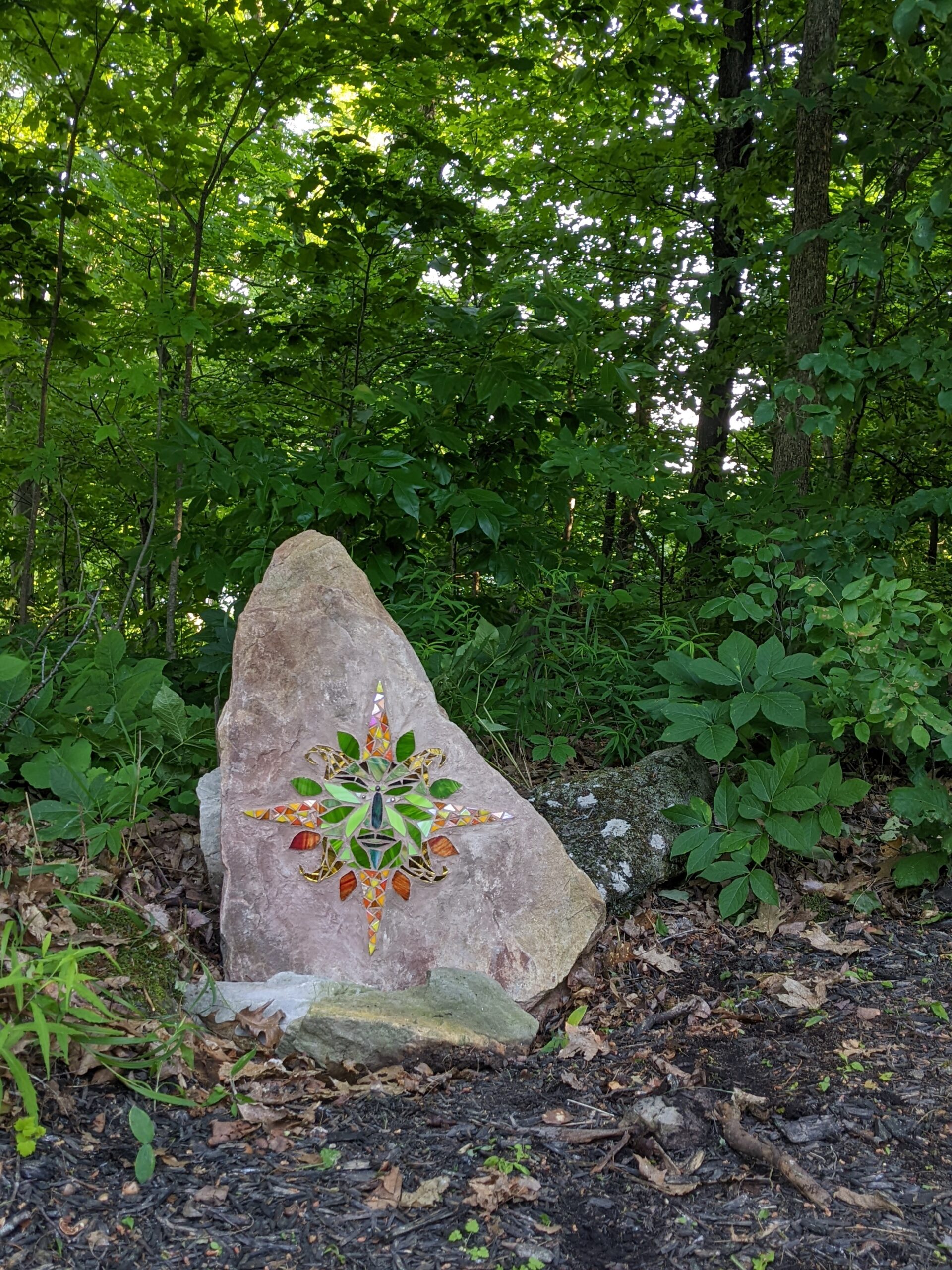
In creating my representation, I combined the Green Man with a Sun image. I tried to pick up Spring and Summer greens together with Autumn’s bronze and gold, honouring those ‘cycles of renewal’. I also wanted to access something both ‘ancient’ and ‘energetic’. There is even a hint of the ‘Horned God’.

Feminine ‘Goddess’

My Mother/Goddess image draws on classic Goddess symbolism. I have never, though, seen colour used this way. This form came to me during a group meditation. I had a strong sense of the way the Goddess connects to grounded, earth energy, deeply rooted. She has generative fire in her belly. But she also connects to Moon energy and to the ethereal. This connection is an incredibly powerful force.

As with the masculine image, I mapped out words and phrases that underpinned my conceptualization of the feminine:

  • Connection and relationship
  • Abundance
  • Fertility
  • Healing
  • Wisdom
  • Being
  • Spirit
  • Transformation
  • Nature
Mother/Goddess Mosaic

Distinct Energies

Working on these two pieces gave me an even deeper inner sense of the difference between these two energies. I believe all of us contain and have access to both. But I can see more clearly how these tend to play out in ‘male’ and ‘female’ behaviours and ways of being, which I hope increases my understanding of that ‘difference’. I definitely came away with a sense of the feminine as more grounded and connected, something we badly need.

That inner voice that insisted I could not create or display one without the other felt important. A world in which we truly integrate the elemental masculine and feminine would look so very different.

The Language of Animacy

In the beginning was the Word . . . Although I don’t identify as Christian so much as Multi-faith or ‘Faith embracing’, that phrase has always resonated at some deep level within me.

Words, language, and the way in which we use them hold such power. Today, savouring my reading of the wonderful Braiding Sweetgrass, Robin Wall Kimmerer gifted me with one of those precious moments of illumination that shift the world on its axis.

A language of things

I had never particularly thought about how the distribution of a particular type of word in a language may mediate our relationship with the world. English is a noun-based language, a language of things. We make that which is not human an ‘it’, an object. Potentially, in so doing, we create a barrier between the human and everything else that makes it much easier to disrespect, despoil and destroy. Only 30 percent of English words are verbs, the words of being and doing.

Winter Lake Illumination

A language of being

Learning her ancestral language, Potawatomi, Robin Wall Kimmerer was initially bewildered to discover that 70 percent of its words are verbs and that, whilst there is no dividing the world into masculine and feminine, the use of language is shaped by whether something is perceived as animate or inanimate.

It was the word for ‘bay’, which reads more like ‘to be a bay’, that provided that vital spark of understanding.

In that moment I could smell the water of the bay, watch it rock against the shore and hear it sift onto the sand. A bay is a noun only if water is dead. . . But the verb wiikwegamaa – to be a bay – releases the water from bondage and lets it live. “To be a bay” holds the wonder that, for this moment, the living water has decided to shelter itself between these shores, conversing with cedar roots and a flock of baby mergansers.
Braiding Sweetgrass, Robin Wall Kimmerer
Tweet

This ‘grammar of animacy’ extends not just to plants and animals. It includes rocks and mountains, water and fire, places, sacred medicines, songs, drums, stories – anything that is imbued with spirit. The inanimate forms of language are largely reserved for objects made by people. It strikes me that, in our English speaking and many other Western cultures, our art, our music, our poetry is often an attempt to reclaim animacy.

Animate or inanimate?

I remember my daughter at a very young age fascinated by making the distinction between male and female, boy and girl. Today I find myself looking around me with the same fascination, trying to distinguish between animate and inanimate.

I hold up a small candle, burning in a glass jar. The glass and the candle itself feel inanimate, though the changing state of the wax gives me pause for thought. But the flame is so obviously animate.

Looking at my nightstand, made from reclaimed wood, I address it as something inanimate, but which has also once been animate. I wonder, though, if a table imbued with love, with a reverence for the tree from which it is hewn, built with artistry and skill, is animate or inanimate?

'Somebody' who visits almost daily - rabbit in snow
‘Somebody’ who visits almost daily

In truth, I identified at least to some extent as an animist from my teens, so this is not entirely new territory. The last five years, living so close to nature, this sense has bubbled up with increasing vigour. I perceive the Lake as my greatest teacher, so obviously ‘alive’. I automatically think of the creatures we see or become aware of as beings, as ‘somebody’, even the ticks and the mosquitoes! Likewise, the trees and plants, with whom my relationship deepens as each season passes. This sense of animacy and its implicit connectedness is part of the underpinning of my sense of joy.

I can’t help wondering, now, how other languages reflect and shape their speakers’ relationship with the world – what a fascinating area of study for one of my parallel lives.

Braiding silence with animacy

How wonderful it would be to have a living language, imbued with this sense of being, in which to think and speak and write. Some thirty years ago, I wrote a poem entitled The Speaking of Silence. I still aspire to learning the language of silence. But now I would wish to find some way to braid it together with the language of animacy.