Gratitude is good for you!

(The third of three interconnected posts on gratitude)

Increasingly science suggests that gratitude is good for us.

Research by Robert Emmons indicates that people who consciously focus on gratitude experience greater emotional wellbeing and physical health than those who don’t. Gratitude:

  • Brings us happiness, boosting optimism, joy, pleasure, enthusiasm and other positive emotions.
  • Reduces anxiety and depression.
  • Is good for our bodies, strengthening the immune system, lowering blood pressure, reducing symptoms of stress, illness and aches and pains and encouraging us to take care of ourselves.
  • Improves sleep
  • Makes us more resilient
  • Strengthens relationships
  • Promotes forgiveness
  • Feeds altruism and compassion

In particular, says Emmons,

“I see it as a relationship-strengthening emotion because it requires us to see how we’ve been supported and affirmed by other people.”
Greater Good Website – Why Gratitude is Good

He suggests that “true gratitude involves a humble dependence on others”, whether other people or ‘higher powers’ and lists four reasons for its transformative power:

  1. It allows us to celebrate the present and magnifies positive emotions
  2. It blocks toxic, negative emotions
  3. It provides resistance against stress
  4. It results in a heightened sense of self-worth

He acknowledges that the practice of gratitude can be challenging. It is predicated on acceptance rather than control. It is at odds with the ‘self-serving bias’. It contradicts the ‘just-world’ hypothesis, which says that we get what we deserve, and the sense of ‘entitlement’ that rest on this.

Cultivating gratitude, therefore, has to be a conscious choice and lifelong practice.

The infomatic below, included by Robert Emmons on the Greater Good website, gives a great sense of why you might want to cultivate the practice of gratitude.

What good is gratitude? Infomatic

For more details of this fascinating research, I would encourage you to explore the University of California, Berkeley Greater Good website.


(See also Gratitude and Joy – an intimate relationship and Grateful to whom?)

Gratitude and joy – an intimate relationship

(The first of three interconnected posts on gratitude)

I am increasingly inclined to think that joy and gratitude are close companions, engaged in a mutual dance of enrichment.

When we experience that moment of joy, whether at the birth of a child or in witnessing a beautiful sunset, is it possible to feel joy without a sense of gratitude?

Joy and gratitude for an Outouais Sunset

Perhaps gratitude can exist without joy, but I think ‘the practice of gratitude’ at the very least primes us to experience joy more readily.

So how do we define gratitude? The dictionary definition is simply ‘the quality of being thankful’. Robert Emmons, possibly the world’s leading scientific expert on gratitude, expands on this, describing it as an affirmation of goodness and a recognition that the sources of this goodness are outside ourselves (see his full definition at the University of California, Berkeley Greater Good website).

A hundred or so years B.C., Cicero argued that among virtues, gratitude is ‘the parent of all the others’, a virtue that begets other virtues. This is backed up by contemporary social scientists who contend that gratitude ‘stimulates moral behaviour’.

I experience gratitude as a state of being, one which provides the lens through which I choose to experience life. As with joy, I am conscious that gratitude is a practice that must be cultivated. I share the Buddhist perception that such a practice leads to the direct experience and awareness of the inter-connectedness of all of life and of the ongoing dynamic of giving and receiving. As well, it creates a context of abundance.

Gratitude also roots us more firmly in the moment. As the Chopra Centre puts it:

“gratitude brings our attention into the present, which is the only place where miracles can unfold. The deeper our appreciation, the more we see with the eyes of the soul and the more our life flows in harmony with the creative power of the universe.”
https://chopra.com/articles/cultivate-the-healing-power-of-gratitude

Whilst gathering my thoughts for this post, the phrase ‘a state of grace’ flickered through my consciousness. Given that the words ‘gratitude’ and ‘grace’ share a common root, this is unsurprising. But what does this mean to our understanding of gratitude?  Vipassana (insight) meditation teacher Phillip Moffitt expresses this beautifully:

“This grace of conscious life, of having a mind that can know “this moment is like this,” is the root of all wonder, from which gratitude flows. The wonder, the mystery, is that you, like everyone else, are given this short, precious time of conscious embodiment in which you can directly know life for yourself.”
http://dharmawisdom.org/teachings/articles/selfless-gratitude

(See also Grateful to whom? and Gratitude is good for you!)

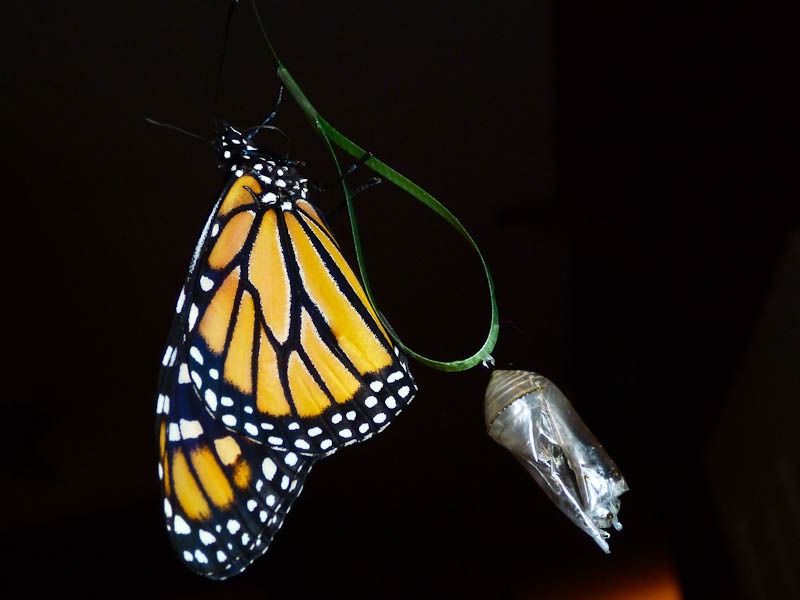
Flying Free

Monarch Butterfly

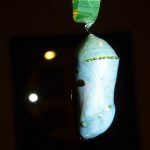
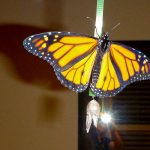
A dear friend gifted me with the wonder of a Monarch butterfly chrysalis – exquisite in its own right; blue green, studded with gold. But the gist of his gift was the opportunity to witness the process of transformation.

We hung the ribbon to which the pupa was attached above our dining table, watched it through breakfast and checked back regularly over the course of the day. Needless to say, we missed the moment of transformation, which must have taken place between 6 and 8pm!

It struck me that this suited the metaphor of our own transformations extraordinarily well. We are rarely fully aware of a single moment of transition from one stage to another. Only in hindsight is the shift apparent.

Of course, the truth is that transformation is not a single moment – for a Monarch Butterfly or a human being. It is a continuous, lifelong process, punctuated by periods of struggling to break free of what we have been and those wondrous, joyous times when we find new wings!

Thank you, Real, for a beautiful gift.

More joy of food and drink

Recent experiences of tasting menus have inspired us to challenge sommeliers to come up with non-alcoholic pairings.

Twice now they have responded with such a genuine sense of interest and enjoyment (and last night Paul got his drinks for free!) that it has also provided an additional quality of delight in our experience of eating out. I have a sense that this kind of playful challenge is another way of creating a shared connection into the wellspring of joy.

In an interesting subtext to this challenge, why should we value the experience of those who drink alcohol over those who choose not to? Restaurants often fail to consider the non-drinker and have poor options, even though there are some wonderful syrups, juices, teas and more, many of which can be locally sourced and mixed to great effect.

I’d like to think that, in playfully planting this awareness, we may help to change this.