There is an increasingly clamorous cultural narrative about the invisibility of women over fifty. Whilst it is important to challenge any form of marginalization, I think it is also valuable to embrace our own personal stories. And I don’t believe that these have to be dominated by a negative sense of invisibility. We have choices.
The narrative is not entirely false. In my late sixties, I have sat at the edge of a younger group in a large gathering and dared to say something only to be blanked as if I am not really there.
But, honestly, often I now feel more visible in ways that matter to me than I did as a younger woman.
The visible self
I think that a part of that perception of visibility or invisibility rests in our sense of ourselves. It takes time and effort to understand who we are as we move into a life stage so much less defined by career and appearance. But unless we are able to vision who we are becoming, then to some extent we are not fully visible to ourselves.
Coming to Canada at fifty-one, I made a very conscious choice to live as authentically as possible. What needs I may have had for approval, to be ‘liked’, had significantly diminished by then. To my surprise, I found an immediacy of deep connection with others as never before, people I call ‘heart-kin’.
I had become interested in developing an understanding of what elderhood might look like in contemporary society in my forties when I worked in dementia care. I now began to delve deeper into this (see Sage in training – modern elderhood – Passage To Joy) and what it might mean to me to embrace Crone qualities (see The season of the Crone – Passage To Joy). It didn’t happen overnight, but I have gradually come to a clear sense of who I am and want to be moving forward, as well as of those things I want (and need) to let go of.
I am perhaps more fully visible to myself than ever before, able to see what feeds my soul and what depletes it. There is an incredible energy and sense of freedom in this.
Sitting in meditation one day, I had a delightfully ‘silly moment’ when the thought that popped into my head was ‘I want to be a lighthouse when I grow up’. This became the basis of the Sankalpa, affirmation, that I use in Yoga Nidra and other contexts:
‘I am radiant with health, love, joy and abundance’.
Choosing to be seen
I don’t know if or how this transmits to others, though at some level it seems to. It would certainly be my wish to carry with me some sense of light.
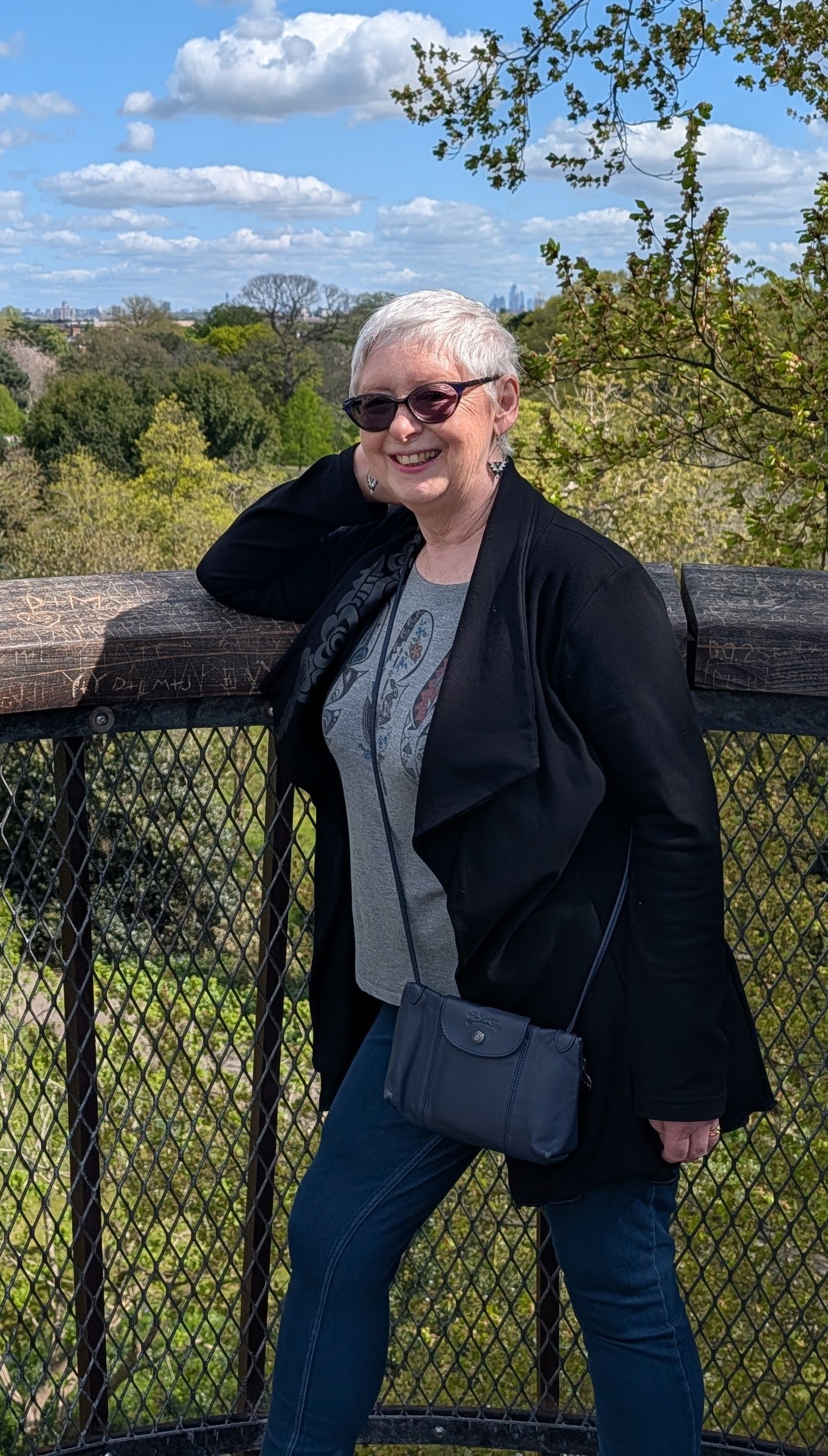
I am still surprised when young women comment ‘I love your dress, your earrings’. That kind of visibility feels unexpected at my age. Sometimes it comes out of nowhere, but more often it emerges from a deeper conversation.
I was definitely startled by the young man in a coffee shop who opened what turned into a deep conversation with ‘are you a very spiritual person?’ He claimed to see my aura and looked to me for insights.
There was the group of much younger colleagues at a conference who, when I commented on our relative age, paid Paul and myself the loveliest compliment: ‘yes, but you have young energy!’ I wear my wrinkles as a badge of honour. But I hope to carry forward joy, zest and an ability to embrace life to the full for as many years as I am granted.
Most recently there was a wonderful conversation in the AGO (Art Gallery of Ontario) with a young man who had just graduated and was considering his next steps. As we contemplated a beautiful print by Newfoundland artist David Blackwood, an extraordinarily deep if fleeting connection seemed to form. Some twenty minutes later, he was seeking my guidance on thoughts that might be important in shaping a good life.
My daughter teases me for my willingness to talk to anyone and for my openness. But the depth of these brief encounters with much younger people is often startling, rich, joyous and humbling. I experience them as a delightful and heartwarming gift. I am also honoured to be allowed to see into the lives of these young strangers. It is not that ‘being seen’ is particularly important to me in itself. But it seems to open up a connection that is genuine and meaningful.
So I choose to be seen and rarely feel invisible.
The cloak of invisibility
For many women, though, there is a relief in casting off a requirement to pander to social expectations of appearances and roles and donning a cloak of invisibility. They revel in saying what they want and knowing that they can get away with it. They go their own way uncensured, unnoticed, with freedom to observe, think and act, and find it profoundly liberating, a secret super-power. The release from the demands and needs of others may be experienced as a quiet joy rather than a loss.
Liberty
“The truth is, it’s only when you stop worrying about becoming ‘invisible’ that you are able to see yourself. Then you are free. Free to decide what matters to you and what never will, whose opinions you value and whose you can disregard, and what exactly is worth your precious hours on this earth and what is a waste of damn time. And really, what could be more beautiful than that?”
Benedetta Barzini, quoted in Wit & Wisdom from 14 Age-Defying Women in British Vogue
If we stop fearing aging and recognize it as the gift it is, we are much more able to see into the heart of ourselves, our true beauty. And once we are visible to ourselves, the choice is ours as to how we shape the narrative of our visibility.


