Not ‘still’ winter – perhaps the deepest transformation

When I look out at the white expanse of frozen lake, I no longer see winter as a small death, a time of darkness, a pause for breath.

I see a continual and wondrous process of transformation!

Ice is not static, but constantly changing.

In early winter’s deep cold, it was confusing that, this year, the ice seemed slower to come in. But with the cold came blankets of snow.

Each rock or dock intruding into the ice creates its own disruption.

Sometimes there is just whiteness, sometimes pools of lavender; sometimes the smoke that isn’t smoke billows around the islands. There are times of diamond brightness. Sometimes the world disappears.

Even in the heart of winter, somewhere, unseen, life goes on beneath the surface, even if I only know this by the presence in spring of turtles, frogs and fish.

The slow seeping of water bubbling out of the ground seeks its way through the ice creating a path – or a fault line?

A fallen oak leaf, absorbing light rather than reflecting it like the white surface that surrounds it, carves out space around itself.


What astonishes me is not just the overt shift from the fluidity of water to the apparent solidity of ice; nor is it the the purity and clarity of unbroken white, the illusion of stillness.

It is the awareness of a profound process of constantly occurring change.

Perhaps winter’s is the deepest transformation of all.

 
Snow-down

Snow Meditation 

Snow falls silently as large crystals,
each, unimaginably, different, unique;
remains like goose-down,
softly blowing.

With thaw, the feathers congeal.

Freeze creates of them
a crisp shell,
hard and resonant.

Then, nothing.

March 2018

Flexing very stiff poetry muscles, exploring eternal life

In a still very tentative flexing of underused poetry muscles, the idea behind the poem below came to me so vividly that it had to be written, even if not well! It speaks to a sudden deep internal awareness that particles are more or less constant in the universe; so all of us, in a way, have an eternal existence.

Eternal Life

When my human days are done

and I walk the path of the long goodbye

I will not be gone.


Will some particle of me take form

in rock or stone,

ruby’s heart or emerald’s gleam?


Or will my flash of green and red,

touched with gold,

draw your eye to the blur of hummingbird wings?

 
Lake and sky
 
 
Within the flow, catching the light

of the lake’s constant changing –

Is it there I’ll be?


Perhaps, in the creaking of branches

and the susurration of leaves,

you’ll sense a trace of me still.


Or maybe I’ll be a sprinkling

of stardust on indigo

somewhere far out in the universe.


It’s somehow comforting to know

that the particles that make up ‘I’

may scatter, but they (almost) never die!


February 7, 2018


I wrote my first poem before I could actually transcribe the words onto paper.

Then, in my teens, poetry and my deep connection to the natural world saved my sanity in an era when no-one considered the impact of significant loss and grief on an adolescent.

Every now and again, amid the roller-coaster demands of just living a life, the poetic impulse has bubbled briefly to the surface.

Now it feels as if it is time once again to tap into this part of me. But oh how rusty I feel, how hard it is not to become self-conscious, to lose the flow, to try too hard or not enough – I’m not yet sure which!


Flying Free

Monarch Butterfly

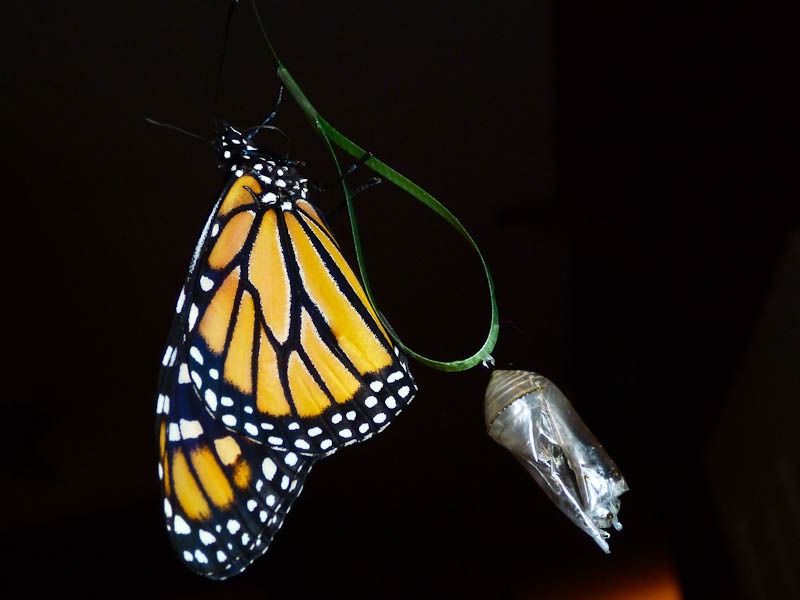
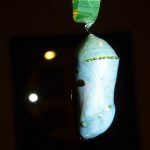
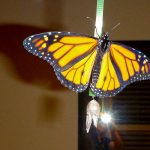
A dear friend gifted me with the wonder of a Monarch butterfly chrysalis – exquisite in its own right; blue green, studded with gold. But the gist of his gift was the opportunity to witness the process of transformation.

We hung the ribbon to which the pupa was attached above our dining table, watched it through breakfast and checked back regularly over the course of the day. Needless to say, we missed the moment of transformation, which must have taken place between 6 and 8pm!

It struck me that this suited the metaphor of our own transformations extraordinarily well. We are rarely fully aware of a single moment of transition from one stage to another. Only in hindsight is the shift apparent.

Of course, the truth is that transformation is not a single moment – for a Monarch Butterfly or a human being. It is a continuous, lifelong process, punctuated by periods of struggling to break free of what we have been and those wondrous, joyous times when we find new wings!

Thank you, Real, for a beautiful gift.

Architectural Joy (ideaCity 2)

I was awed by the magic of Rachel Armstrong’s vision of a living architecture, creating a state of transformation, a language of metabolism, materials able to colonise a technological framework in symbiosis.

She showed us film of substances  that we normally perceive as inanimate (water, with olive oil and alkali) behaving like self-organizing systems.

The development of materials that possess a metabolism for use in architectural practice would confer some of the properties of living systems on our cities. These metabolic materials would enable architecture to change over time using local sources of energy and raw materials and respond to variations in the urban environment.

From Rachel Armstrong’s web site

I do not begin to understand either the science or the possibilities implied by this vision and for now it is just that; metabolic materials do not yet exist in practice. But joy was there in her fierce passion. And joy is truly present in her work with Philip Beesly on Hylozoic Ground for the Venice Biennale 2010 – utterly amazing!

Hylozoic Ground is an immersive, interactive environment that moves and breathes around its viewers. This environment can ‘feel’ and ‘care’. Next-generation artificial intelligence, synthetic biology, and interactive technology create an environment that is nearly alive.

From the Hyzoloic Ground Website